
Timothy gooley
EVIDENCE & ARTIFACTS

SEDA Education Support Program
“In an effective classroom students should not only know what they are doing, they should also know why and how" (Harry K. Wong)
AITSL Addressed;
1.3 Students with diverse linguistic, cultural, religious and socioeconomic backgrounds
6.1 Identify and plan professional learning needs
6.2 Engage in professional learning and improve practice
PoLT Addressed
1.1 builds positive relationships through knowing and valuing each student
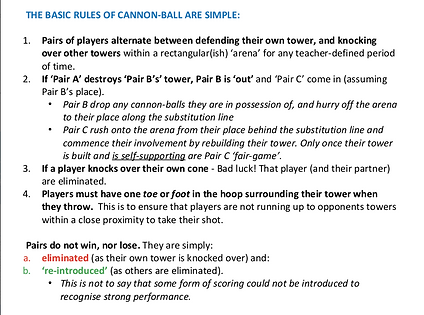
During practicum with SEDA in 2015. I volunteered my time at the ‘Education Support’ program held each Wednesday. The role included tutoring individual students with a range of learning difficulties, in an aim of getting them up-to-date with their work. I assisted registered teachers and education coordinators in the role, where we would break at the middle of each session and have an informal meeting over lunch at a nearby café. The wealth of knowledge I took from communicating professionally with experienced staff sparked a real desire to learn and practice to be the best teacher I could be in my own unique style. Regularly discussing areas such as individual learning difficulties, learning styles, teaching strategies, individual learning plans, assessment and student engagement on a regular basis gave me extensive experience that I look to pass onto my students. As my colleagues, mentors and the SEDA organisation were impressed with my work ethic and ability; they went on to offer my volunteer role as a paid part time position for the second half of the year. I willingly took the position and relished the opportunity to be a part of a professional education organisation such as SEDA. I took away many experiences from all staff, students and employees within the organisation that I endeavour to enrich my future students in.


activity resources (above)
AITSL Addressed;
6.3 Engage with colleagues and improve practice
7.4 Engage with professional teaching networks and broader communities
PoLT Addressed;
6.2 plans for students to interact with local and broader communities and community practices
Throughout my final placement I learnt the value of collaborating with colleagues. Ansmann et al. (2014) explains ‘Innovations and opportunities in research, education and practice often result from collaborations between or among academics with different skills and resources’. As a teacher it is imperative to continuously source new ways of learning and teaching in order to always offer the greatest opportunities for my students. During my internship my mentor and I visited a number of my mentor’s professional colleagues at neighbouring schools. Together we observed and interacted with their Physical Education classes and discussed professional practice. This experience was extremely resourceful for my development in professional knowledge and practice through the collaboration with individuals also motivated by getting students physically active. I was able to alter my method of teaching and incorporate my new knowledge into my teaching to benefit the learning of my students. The above slides are an example of the collaboration between colleagues where resources were shared between different parties. This resulted in students being exposed to new activities throughout P.E where there was a discussion of holding a carnival with all schools involved to compete against one another in the newly shared activities.Professional development is an integral part of teaching and learning and is something I look to continuously develop (Ansmann et al 2014).

Humanities Unit
AITSL Addressed;
1.4 Strategies for teaching Aboriginal and Torres Strait Islander students
2.4 Understand and respect Aboriginal and Torres Strait Islander people to promote reconciliation between indigenous and non-indigenous Australians
PoLT Addressed;
1.2 promotes a culture of value and respect for individuals and their communities
4.5 uses strategies to develop investigating and problem solving skills
The Humanities Unit I developed in 2016 included links to Kolbs’s (1984) experiential learning. As the students learning focus was on Aboriginal history and culture, the lessons were developed around an excursion to the Bunjilaka exhibition at the Melbourne Museum.This is directly integrated with Kolb’s experiential learning model (1984) where students are involved in a concrete experience, which can transform their way of thinking.
The content to be taught through these activities was designed to engage students at level 3 to explore events and aspects of the past that make who we are today as a country and a community. This will be done through a specially designed set of lesson activities including an excursion to the Melbourne Museum where the students will visit the Bunjilaka exhibition. The Bunjilaka exhibition celebrates the Aboriginal history from the time of creation to present day. The major exhibition also delves into the Aboriginal culture, achievements and the survival of the Aboriginal people. The excursion will give students an opportunity to immerse themselves in Aboriginal knowledge through a ‘hands on’ and engaging manner. Students will be looking at Aboriginal art forms, examples of historic Aboriginal clothing, hand made tools, sporting memorabilia and will be able to explore the use of technology throughout the exhibition where they can sit down and have an aboriginal person aged anywhere from 8 to 72 years old talk to them about their experience and culture as an aboriginal person.
The students will explore key concepts that Aboriginal and Torres Straight Islander have such as the significant connection to the land and country and have unique beliefs both physically and spiritually. Students will explore their different forms of language, experiences, and different ways of being, thinking, knowing and doing. Finally the contribution of both Aboriginal and Torres Straight Islanders on both a national and global scale will be addressed. (ACARA 2016)

SEDA Literacy Lessons
AITSL Addressed;
1.1 Physical, social and intellectual development and characteristics of students
2.5 Literacy and Numeracy Strategies
3.5 Use effective classroom management
PoLT Addressed;
1.4 ensures each student experiences success through structured support, the valuing of effort, and recognition of their work.
2.2 uses strategies that build skills of productive collaboration.
I believe it is important to assist students to develop their skills to be able to critically self-assess and participate effectively in peer assessment. It is also important for students to learn how to work simultaneously as a team to create achievable learning goals. Whilst on practicum at SEDA in 2015 I was given the opportunity to run effective reading and writing literacy conferencing groups that focused on self and peer assessment. During group conferences students openly shared their ideas and gave constructive feedback to each other and myself. It was clear that students felt safe in their environment to contribute to small group discussions and they demonstrated a strong understanding of what was required from each individual in order to continually improve their learning.
Parents
AITSL Standards Adressed:
3.7 engage parents/carers in the educative process
5.5 Report on student achievement
7.4 Engage with the parents/carers
As a pre-service teacher in the P.E setting this year, I have been somewhat limited in terms of building constructive relationships with parents. Therefore, I made it a personal ambition of mine this year to connect with all parent teachers at Kalinda Primary School. I had multiple conversations with teachers on the progress of their child in P.E where they were always appreciative to be kept inform of their child’s progress. These conversations were exceptionally valuable as I prepare myself to be able to converse effectively with student’s parents, where I found links to student output and involvement were often made from discussing the happenings at home. I also took every opportunity to talk to parent volunteers whilst assisting with foundation’s PMP sessions each week. I found the conversations to be extremely helpful in terms of getting to know the student and how they learn, as often parents explained reasoning behind certain issues being faced in the classroom.


Google Drive P.E Resource
However deviating somewhat from the initial goal of a ‘CRT Resource’ the project concluded taking the shape more so of a general ‘P.E Resource’. Still easily navigable for the eyes of a last minute CRT inclusion, the resource took the form of a Google-drive resource with several folders linking to necessary sports, activities and lesson plans. Being deemed a success the project has been shared between both my partnership school and I to be used and further added to. The project has provided me with an exceptional resource going forward with my development as a teacher and will be something I will use as an aid when developing future unit and lesson plans. In turn, it has provided my partnership school with a digital resource to aid relief teachers and P.E teachers alike. The P.E setting at Kalinda Primary has now ‘gone digital’ in a sense that all of the valuable resources gathered over time are now easily accessible online, where the hardcopies that were once gathering dust taking up office space have been dispatched.


FMS Lessons
AITSL Addressed;
3.3 Use teaching strategies
PoLT Addressed;
3.2 uses a range of strategies that support the different ways of thinking and learning
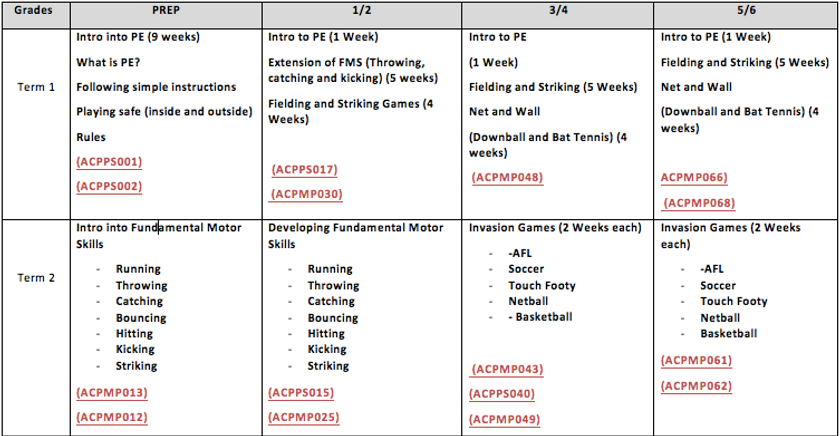
Throughout 2016 I developed a sequence of Fundamental Motor Skills (FMS) lessons at a 1/2 level specific to the AusVELS Standards for Kalinda Primary students. The lessons intended to develop the students’ basic fundamental skills to enable them to use in everyday activity and tasks, before moving onto more complex skills at a later level. I implemented these tasks in a setting that catered for an extensive range of learning levels where I used a variety of grouping strategies including whole class, independent and small group based, all to enhance student achievement, motivation, independence and interdependence. My lessons commenced and concluded with a short informal discussion with students, which provided me with a basis on where to progress for the lessons to follow. Throughout the particular FMS lessons I used a number of strategies such as game based learning. This provided the students with a chance to use the skills we had been working on in a game sense where I found this strategy particularly engaging as students’ witness how their ‘training’ can be used in a practical sense. I feel that as a teacher it is imperative to continuously source new ways of learning and teaching in order to always offer the greatest opportunities for my students.
P.E Unit Plan
AITSL Addressed;
2.2 Content selection and organisation
3.2 Plan, structure and sequence learning program
PoLT Addressed;
5.1 designs assessment practices that reflect the full range of learning program objectives
5.3 make assessment criteria explicit
My ability to address the Standards, Assessment and Reporting Advice and PoLT were demonstrated in 2015 when I developed an annual Physical Education curriculum for all levels as part of my Primary Physical Education major. After researching the standards to ensure I had a full understanding of the requirements for this particular level I went on to research the Assessment and Reporting Advice to construct a unit that could be effectively assessed using a range of assessment strategies. These included formative, diagnostic and summative types of assessment. This was to validate that student performance could be successfully measured. Throughout this process I created lessons in a way that catered for the diversity of students where I could implement a range of teaching and learning strategies. Lessons also made connections to the 5E Inquiry Model, which broke down the five phases of the model, engage, explore, explain, elaborate and evaluate.


PMP
“You can teach a student a lesson for a day, but if you can teach them to learn by creating curiosity, they will continue the learning process as long as they live” (Clay P Bedford)
Volunteering once a week with the Foundation students Perceptual Motor Program (PMP) I was able to build a fantastic rapport with the students. Seeing Foundation for an extra lesson each week meant I was able to get to know students individually, how they best learnt, how they thought their way through situations whilst observing and assessing their success over an extended period of time.
From my time in foundations PMP sessions, I drew on Jerome Bruner’s discovery theory (1966) that learning takes place through problem solving situations where the learner draws on their past experience. I found this to be evident as PMP faced foundation students with a challenge in which there was minimal support from helpers, instead relying on the student to think their way through the problem. As a result, students may be more likely to remember concepts and knowledge discovered on their own( Bruner 1966).


STUDENT TESTING
CYBER SAFETY LESSONS
AITSL Adressed;
7.1 Meet professional ethics and responsibilities
PoLT Addressed;
3.4 capitalises on students' experience of a technology rich world.
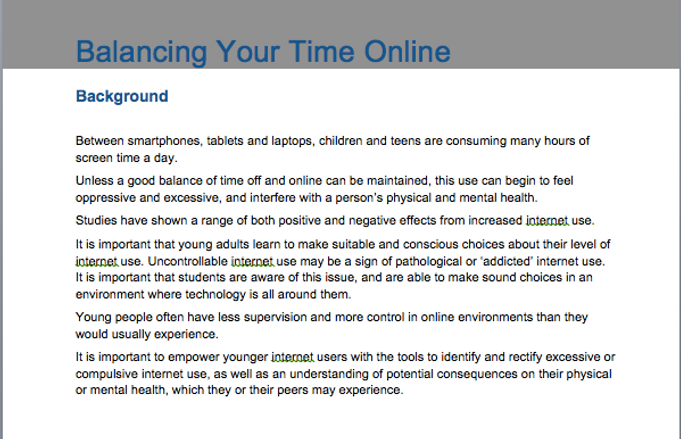
In 2015 I taught a series of lessons on Cyber Safety (eSafety Government Australia 2015). The lessons were aimed at my 16-18 year old SEDA students and were extremely current. The lessons included issues such as sexting, digital citizenship and balancing screen time. I found the students to take a lot from these lessons as they were really well received, prompting plenty of interesting group discussion. Cyber safety lessons were prompted due to both the age group and the prevalent amount of time students were spending online.
‘One of the most important (principles of good teaching) is the need for planning. Far from compromising spontaneity, planning provides a structure and context for both teacher and students as well as a framework for reflection and evaluation’ (Spencer, 2003 p. 25)
Glasson (2009) suggests conducting summative tests are likely to only provide a snapshot of student learning. However summative tests provide teachers with useful formative information on the learning that has taken place to then be used to form future teaching and highlight areas for development.